
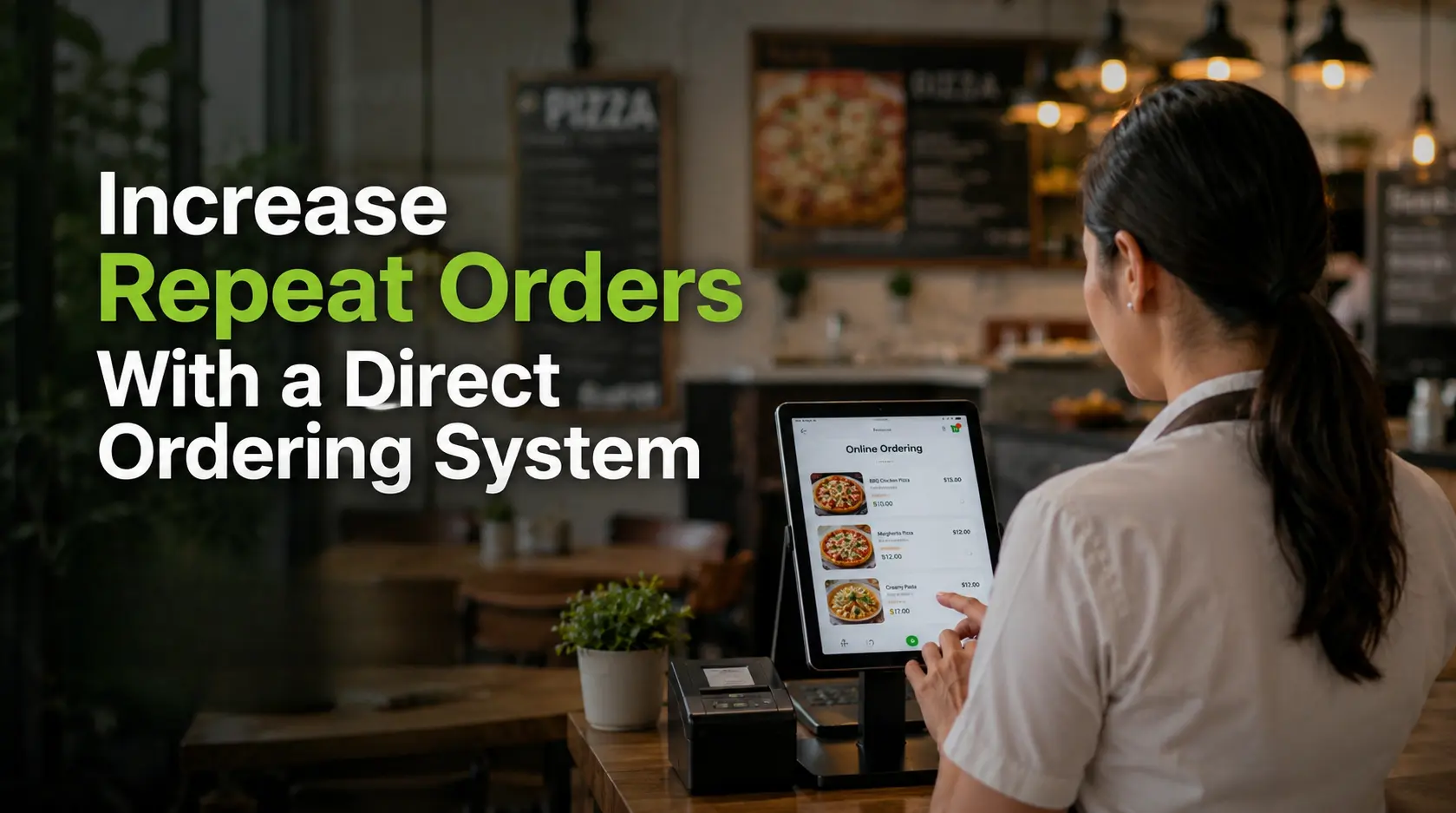
Restaurants increase repeat orders by making the second purchase easier, keeping their brand in front of customers, and giving people a reason to return. A direct ordering system helps bring those pieces together by giving customers a simple way to order from the restaurant’s own website instead of relying entirely on third-party food delivery marketplaces.
With Own Your Order, restaurants can create a branded online ordering channel, manage their menu, collect customer information, promote offers, and build a direct relationship with customers.
Getting a customer to place one order is only the beginning. The real value comes when that customer remembers your restaurant, returns to your website, and orders again.
Why Are Repeat Orders Important for Restaurants?
Repeat customers already know your food, your service, and your brand.
That removes some of the uncertainty that comes with acquiring a completely new customer.
A first-time customer has to decide whether your restaurant is worth trying. A returning customer has already made that decision.
This makes customer retention an important part of restaurant growth.
Repeat customers can:
- Order more frequently
- Try additional menu items
- Respond to loyalty programs
- Recommend the restaurant to others
- Become familiar with direct ordering
- Generate revenue without requiring the same level of customer acquisition effort
The goal is not simply to increase the number of orders. It is to create a customer journey that naturally encourages the next order.
Why Do Restaurants Lose Repeat Customers?
Customers do not always stop ordering because they disliked the food.
Sometimes the restaurant simply disappears from their attention.
A customer may have ordered your pizza three weeks ago, enjoyed it, and still forget about your restaurant when they want pizza again.
Other problems can make repeat ordering harder:
- Customers do not know where to order directly
- The website is difficult to navigate
- The menu is outdated
- The checkout process takes too long
- Customers receive no relevant offers
- The restaurant has no loyalty strategy
- The customer only associates the restaurant with a third-party app
- Ordering information is difficult to find
A direct ordering system gives restaurants more control over these touchpoints.
What Is a Direct Ordering System for Restaurants?
A direct ordering system allows customers to place food orders through a restaurant’s own digital channel.
Instead of:
Customer → Delivery Marketplace → Restaurant
the customer can order through:
Customer → Restaurant Website → Online Ordering System → Restaurant
The restaurant’s website becomes an active sales channel rather than simply an information page.
Own Your Order provides restaurants with a branded website, online ordering, menu management, order notifications, and order management tools designed around direct restaurant ordering.
How Does Direct Ordering System Increase Repeat Orders?
The biggest advantage is control.
When customers repeatedly order through third-party marketplaces, the marketplace remains a major part of the customer relationship.
A direct ordering system gives the restaurant its own customer-facing channel.
That allows restaurants to create a consistent experience around:
- Restaurant branding
- Online menu
- Promotions
- Loyalty
- Customer communication
- Ordering
- Repeat purchases
The customer knows exactly where to go the next time they want to order.
That familiarity matters.
1. Make Your Restaurant Website the Home for Online Orders
Your website should clearly tell customers where to order.
Do not make someone search through several pages to find your menu or checkout.
Place an obvious Order Online button where customers can see it.
Customers can reach the website through Google Search, Google Maps, social media, email, QR codes, printed receipts, and restaurant packaging.
Google Business Profile can support ordering links that help customers move from a restaurant’s profile on Google Search or Maps to an online ordering page, depending on eligibility and region.
That creates a much shorter path between intent and purchase.
2. Make the Second Order Easier Than the First
A customer’s first order requires exploration.
They may read the menu, compare dishes, look at prices, and decide what to try.
The second order should feel easier.
Your direct ordering experience should make it simple to:
- Find favorite dishes
- Review the previous order
- Select popular items
- Customize food
- Add items to the cart
- Choose pickup or delivery
- Complete payment
The less effort involved, the easier it becomes for customers to return.
This is where restaurant ordering software, online menus, and mobile ordering become important.
Many customers order food from smartphones, so the ordering process should work well on mobile devices rather than being designed only for desktop users.
3. Give Customers a Reason to Order Again
Convenience helps, but sometimes customers need a reason to return.
Restaurants can use direct ordering to promote:
- Limited-time offers
- Family meals
- Lunch specials
- Seasonal dishes
- New menu items
- Free add-ons
- Direct-order discounts
- Loyalty rewards
- Birthday offers
- Customer-specific promotions
The offer does not need to be expensive.
A small incentive can give a customer the final push they need to place another order.
The important part is making the promotion relevant to the customer and financially sensible for the restaurant.
4. Build a Restaurant Loyalty Program
A restaurant loyalty program gives customers a reason to keep coming back.
The basic idea is simple:
Order → Earn a reward → Return → Order again
Restaurants can structure loyalty around:
- Points
- Discounts
- Free menu items
- Exclusive offers
- Reward tiers
- Visit frequency
- Spending thresholds
For example, a restaurant might reward customers after a certain number of direct orders.
The exact structure depends on the restaurant’s margins and customer behavior.
A good loyalty program should encourage profitable repeat purchases rather than simply giving away discounts on every order.
5. Use Customer Data to Personalize Promotions
Direct ordering gives restaurants an opportunity to understand their customers better.
Useful customer information may include:
- Order frequency
- Favorite menu categories
- Average order value
- Preferred ordering method
- Previous purchases
- Ordering patterns
This information can support more relevant restaurant marketing.
A customer who frequently orders family meals should not necessarily receive the same promotion as someone who regularly orders lunch for one.
Relevant offers are more useful than sending the same discount to everyone.
Own Your Order promotes customer data tools that help restaurants develop their own customer relationships and encourage repeat orders.
6. Use Email Marketing to Bring Customers Back
Email can remind customers that your restaurant is still there.
Restaurants can use email marketing for:
- New menu announcements
- Seasonal promotions
- Loyalty rewards
- Special events
- Holiday offers
- Reorder reminders
- Exclusive direct-order promotions
The goal is not to fill someone’s inbox.
A useful restaurant email gives the customer a clear reason to visit the website and order.
A simple message such as “Your favorite meal is waiting” can work better than a long promotional email filled with unrelated offers.
7. Use SMS Marketing for Time-Sensitive Offers
SMS marketing can be effective for short, timely restaurant promotions.
For example:
Weekend special: Get our family meal deal today. Order directly online.
The message is short.
The offer is clear.
The customer knows what to do next.
Restaurants should follow applicable consent and messaging requirements when collecting and using customer phone numbers for marketing.
8. Use QR Codes to Encourage the Next Order
A QR code can turn a completed order into an opportunity for another one.
Restaurants can place a QR code on:
- Takeout packaging
- Receipts
- Table cards
- Flyers
- Loyalty cards
- Catering materials
The QR code can lead directly to the restaurant’s online ordering page.
Imagine a customer finishing a takeout meal and seeing:
“Order directly next time. Scan to order.”
That small reminder can help customers remember where to place their next order.
9. Keep Your Online Menu Updated
An outdated menu can damage the repeat-order experience.
Customers return expecting the same basic information they saw before.
Prices should be accurate.
Unavailable dishes should not remain prominently listed.
New menu items should be easy to find.
Descriptions should make sense.
Modifiers and add-ons should work properly.
Your digital menu is not just a list of food. It is part of the customer’s ordering experience.
Own Your Order provides menu management tools that allow restaurant teams to update their online menus and keep ordering information current.
10. Use Customer Favorites to Increase Order Value
Repeat customers already have preferences.
A direct ordering system can make it easier for customers to return to familiar dishes.
Restaurants can highlight:
- Best sellers
- Popular combinations
- Customer favorites
- Meal bundles
- Add-ons
- Complementary items
For example, a customer ordering a burger might see fries and a drink as natural additions.
This can increase average order value while keeping the ordering experience simple.
The goal is not to overwhelm customers with suggestions. Show useful combinations that make sense with what they are already buying.
11. Connect Direct Ordering With Your Restaurant POS
A direct ordering system becomes more useful when it fits into the restaurant’s existing technology.
A restaurant POS system can help manage orders, payments, menu information, and day-to-day operations.
When the online ordering system and POS work together, restaurant staff can spend less time manually transferring order information.
That matters for repeat customers because operational problems affect the customer experience.
An easy ordering process does not help much when orders are delayed, missed, or entered incorrectly.
12. Make Pickup Part of Your Repeat-Order Strategy
Direct ordering is not limited to delivery.
Online pickup ordering can be an important channel for restaurants that have local customers who prefer collecting their food.
Customers can place the order through the restaurant website, select pickup, and arrive when the order is ready.
This creates another opportunity to move customers away from third-party ordering channels.
It can be particularly useful for customers who live or work close to the restaurant.
13. Promote Direct Ordering After Every Purchase
Do not wait until a customer forgets about your restaurant.
Promote direct ordering immediately after the purchase.
A restaurant can include a simple message on:
- Digital receipts
- Printed receipts
- Takeout bags
- Food packaging
- Loyalty cards
- Thank-you messages
For example:
“Loved your meal? Order directly from our website next time.”
The message introduces customers to your direct channel while the restaurant is still fresh in their minds.
14. Track Repeat Order Rate
You cannot improve repeat business without measuring it.
Restaurant owners should monitor metrics such as:
Repeat customer rate: How many customers order again?
Order frequency: How often do returning customers order?
Average order value: How much does each order generate?
Customer retention rate: How many customers remain active over time?
Direct-order percentage: What portion of online orders comes through your own ordering channel?
Customer acquisition cost: How much does it cost to acquire a new customer?
These numbers give restaurant owners a clearer picture of whether their retention strategy is working.
Direct Ordering vs. Third-Party Ordering for Repeat Customers
Third-party marketplaces are useful for discovery.
They put restaurants in front of customers who may not know the business.
But restaurants should not rely on marketplace visibility alone to generate every future purchase.
A direct ordering strategy gives restaurants another option.
| Third-Party Marketplace | Direct Ordering |
| Useful for customer discovery | Built around the restaurant’s own brand |
| Customers browse many restaurants | Customers interact directly with your restaurant |
| Marketplace controls much of the experience | Restaurant controls the website experience |
| Orders may involve marketplace commissions | Direct-order costs depend on the restaurant’s system and payment setup |
| Customer relationship is partly mediated by the platform | Restaurant has greater control over customer relationships |
| Competing restaurants appear alongside yours | Your website focuses on your menu and brand |
The best strategy for many restaurants is not necessarily choosing one channel.
It is using marketplaces for discovery while building direct ordering for retention.
How Does Own Your Order Help Increase Repeat Orders?
Own Your Order gives restaurants a direct digital channel for online ordering.
Its restaurant website and ordering platform bring together:
- Branded restaurant websites
- Online menus
- Direct online ordering
- Menu management
- Real-time order management
- Order notifications
- Customer data tools
- Promotional opportunities
- Repeat-order support
This gives restaurant owners a way to build an online ordering experience around their own business.
Instead of treating every order as an isolated transaction, restaurants can build a customer journey that encourages people to return.
What Is the Best Way to Turn First-Time Customers Into Repeat Customers?
Start with the basics.
Make the first order easy.
Deliver a good experience.
Make the second order even easier.
Then give customers useful reasons to return.
That could mean a loyalty reward, a relevant promotion, a favorite-item shortcut, a direct-order offer, or simply a website that customers remember.
The strategy works best when these elements operate together:
Good food → Good experience → Easy direct ordering → Relevant follow-up → Repeat order
A direct ordering system gives restaurants the infrastructure to support that cycle.
Why Should Restaurants Own Their Online Ordering Channel?
The restaurant’s website is one of the few digital assets the business can build around its own brand.
Your menu belongs to your restaurant.
Your branding belongs to your restaurant.
Your customer experience belongs to your restaurant.
Your direct ordering channel should reflect that.
Third-party marketplaces can remain useful, but restaurants benefit from having an ordering destination they control.
That is where a direct ordering system becomes more than a way to process transactions. It becomes part of the restaurant’s customer retention strategy.
Increase Repeat Orders With Own Your Order
Repeat business starts with giving customers a reason to come back—and making that return easy.
Own Your Order helps restaurants build a branded online ordering system where customers can view the menu, place orders, and interact directly with the restaurant.
Instead of relying entirely on third-party marketplaces to bring customers back, build a direct relationship through your own restaurant website.
Create your direct ordering channel with Own Your Order and give customers an easier reason to order again.
Get started with Own Your Order
FAQs
Can a direct ordering system work for restaurants that already use DoorDash or Uber Eats?
Yes. A restaurant can maintain third-party marketplace listings for discovery while promoting its own website to existing customers. This creates a multi-channel strategy rather than requiring the restaurant to depend on one ordering source.
What is a good repeat-order rate for a restaurant?
There is no universal target because repeat-order behavior varies by cuisine, location, average customer frequency, price point, and restaurant type. A better benchmark is your own historical performance. Track repeat customers over consistent periods and measure whether the percentage is improving.
How long should a restaurant wait before sending a reorder reminder?
The timing should reflect how frequently customers typically purchase your type of food. A pizza restaurant may have a shorter natural reorder cycle than a fine-dining restaurant. Use your historical ordering data to identify when customers are most likely to purchase again rather than sending reminders on an arbitrary schedule.
Does a loyalty program have to offer discounts?
No. Loyalty programs can use points, free items, exclusive menu access, early access to promotions, birthday rewards, or other benefits. The reward should encourage profitable customer behavior without training customers to order only when a discount is available.
How can restaurants know whether direct ordering is creating more repeat customers?
Compare customers who place direct orders with your previous ordering data and monitor repeat-order rate, ordering frequency, average order value, and customer retention over time. A restaurant can then see whether customers who use its direct channel are returning more frequently or generating stronger long-term value.
No comment